Research
Machine learning from the structure of scientific, clinical and industrial data.
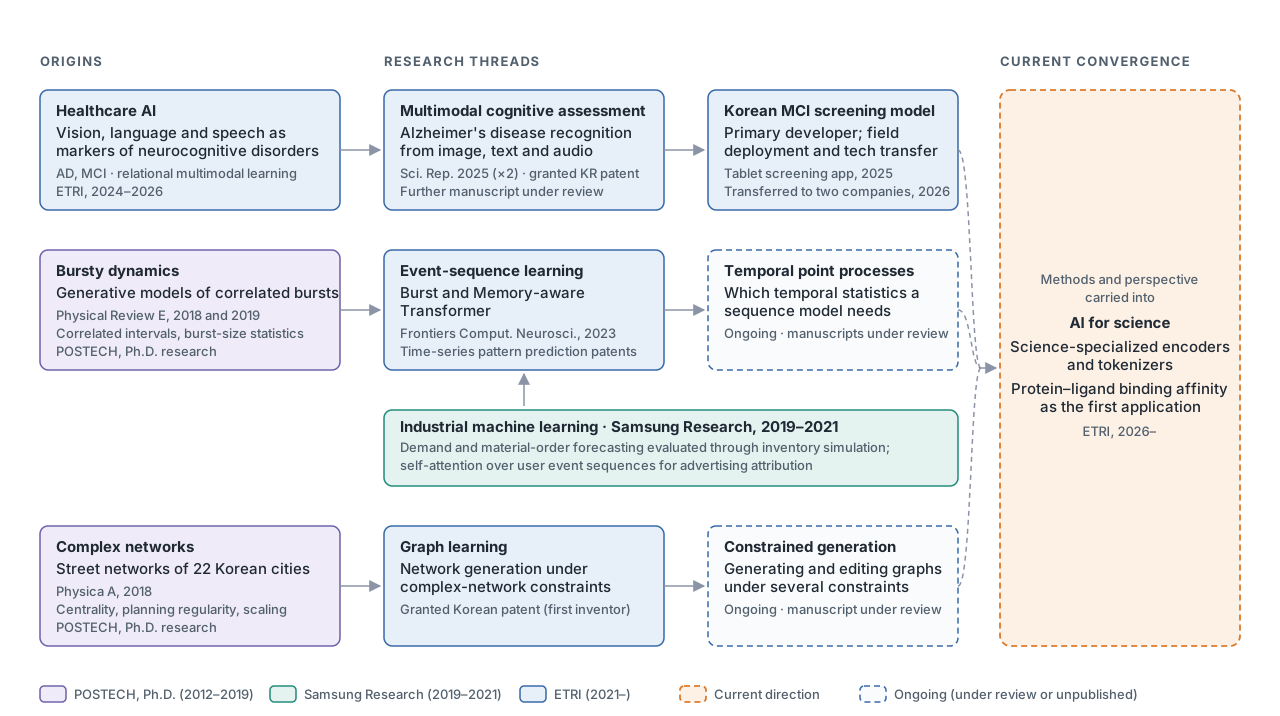
I work on machine learning for scientific, clinical and industrial data, with a background in statistical physics and complex systems. My research asks how the structure of a system, the timing of its events, the relations among its parts and the several modalities in which it is observed, can be turned into models that predict, generate and explain. The work spans four connected areas:
- AI for science and complex systems. Representation learning for scientific data, relations between structure and dynamics, and model validation.
- Graph learning and constrained generation. Complex networks, graph representations, and generating or editing graphs under structural constraints.
- Event-sequence learning. Temporal point processes, bursty dynamics, memory and temporal dependence, and probabilistic prediction.
- Multimodal and data-efficient learning. Combining images, language and speech for cognitive assessment, and learning from limited or imbalanced data.
Current work
Scientific representation learning for drug discovery
At ETRI, I develop science-specialized encoders and tokenizers for molecules and proteins, using protein–ligand binding-affinity prediction as the application. The question is how pretrained sequence representations and three-dimensional structure should be combined, and how well the resulting models generalize beyond the proteins and molecules they were trained on.
New application area since 2026, building on the multimodal and graph-based representation work below. Ongoing; no results published yet.
Event-sequence learning
Temporal point processes model when events happen. This work asks how the statistical signatures of bursty activity, which I studied in my doctoral research, should enter neural event-sequence models, and under which conditions they change what the models predict.
Extends the Burst and Memory-aware Transformer (2023) and my patent applications on time-series pattern prediction. Manuscripts under review.
Graph generation under structural constraints
Many scientific and engineered systems must satisfy several structural constraints at once. This work studies how to generate and edit graphs under such constraints, and which parts of that process learned models can take over from explicit evaluation and search.
Grows out of my granted Korean patent on constrained network generation (KR 10-3005917) and the complex-network work below. Manuscript under review.
Selected research contributions
1. Multimodal learning for cognitive assessment
Picture-description speech connects what people say with the visual scene they describe. To study how these relationships reflect cognitive function, I developed graph models of image–sentence relationships and combined them with text and audio representations through co-attention, examining how visual, linguistic and acoustic cues contribute to Alzheimer's disease classification on the ADReSSo benchmark.
Key finding. The image–sentence graph supported Alzheimer's disease classification on its own, and removing the image–text relations lowered performance, so the relational structure itself carries diagnostic signal. Combining the graph with text and audio through co-attention improved mean accuracy further, with most of the gain coming from co-attention rather than from adding audio. These are results on an English picture-description benchmark, not a clinical validation.
First and corresponding author on both papers. The method is covered by a granted Korean patent (KR 10-2968743, first inventor) and led to the Korean speech-based MCI model described under Projects.
2. Bursty dynamics and temporal point processes
Events in complex systems often cluster in time. I developed a hierarchical model of bursty dynamics and contributed to a copula-based method for controlling inter-event time distributions and memory. Building on this work, I incorporated burstiness and memory statistics into a Transformer for event-time prediction, linking statistical descriptions of temporal heterogeneity with neural sequence models.
Key finding. In the hierarchical model, the known relation between the inter-event time exponent and the autocorrelation exponent (α + γ = 2) still holds when successive intervals are correlated, while burst sizes follow a stretched-exponential rather than a power-law distribution, which marks what a hierarchical mechanism alone can and cannot explain. In the Transformer, burst and memory statistics improved next-event time prediction mainly where temporal heterogeneity was strong, not uniformly across datasets.
3. Complex networks and urban structure
Using street networks from 22 Korean cities, I examined how urban structure relates to demographic and economic characteristics, through centrality measures, planning regularity and population–road-length scaling.
Key finding. Cities grouped by the inequality of their centrality measures shared demographic and planning characteristics, and population–road-length scaling differed between urban and urban–rural cities, so the relation depends on how cities are grouped.
Research directions
Looking ahead, my research program asks what can be learned from the structure and observations of a complex system, and what additional observation or computation is needed to tell competing scientific explanations apart. It rests on the two foundations above: generative models of bursty dynamics leading to event-sequence learning, and complex-network analysis leading to graph learning under structural constraints. Over the next two to three years I plan to pursue it in three stages.
- Near term: temporal statistics and constraint-aware graph learning. Controlled benchmarks that identify which temporal statistics a sequence model needs, and constraint-aware graph generation that combines learning with explicit evaluation. Both continue the manuscripts now under review.
- Bridging goal: representation learning for scientific data. Extending both lines toward representations that preserve the large-scale dynamics of scientific systems, connected to the drug-discovery work under Current work.
- Longer term: cost-aware sequential experimental design. Choosing which observation or computation to make next when each is costly, so that models help tell competing explanations apart rather than only fit the data at hand.
Industrial machine learning
Industrial applications have shaped how I evaluate predictive models, connecting prediction accuracy with the decisions the predictions support. At Samsung Research, I assessed inventory forecasts through their effects on simulated ordering and stock levels.
Collaboration and deployment
In clinical collaborations, I developed models with domain specialists to analyse observed treatment choices. Other collaborations explored predictive coding for recognition with limited or imbalanced data and classifiers that accommodate new features.
- Explainable ML models for a deeper insight on treatment decision for localized prostate cancer
- Brain-inspired Predictive Coding Improves the Performance of Machine Challenging Tasks
- Latent-Variable Classifiers Based on Total Correlation for Dynamic Environments
For applied development and technology transfer, see Projects.